
Gail Lynch (nee Malcolm) was a pupil at West Heath from 1955 to 1960. Here, with aid of her own photographs from that era, she describes some delightful memories of her time at the school and has helped bring some clarity to the details surrounding the accidental death of headmistress Miss Phyllis Elliott. Plus, don’t forget the time she found herself on her own with Prime Minister Harold MacMillan during a party at 10 Downing Street!

When I look back on my school days, so many fond memories come back to me. We all seemed to have rugs, usually tartan, which were as essential as anything else we owned. They kept us warm, of course, but on many occasions they were taken outside and spread in various locations in the grounds where friends and I would read or chat.
The Azalea Garden was our favourite spot, especially when it was in bloom. The aroma was absolutely divine. There was also a beautiful, slightly neglected Japanese garden on the other side of the playing fields, complete with a little bridge that somehow managed to survive the years. We loved wandering off there. It felt like stepping into another world.
Sunday evenings had their own quiet magic. We’d bring our rugs into the main room, curl up on the floor, and listen to classical records. It was entirely optional, but I went every time. There was something deeply comforting about these sessions.
Daytimes were a different story. After lessons we had games, lacrosse, mostly, which I absolutely detested. It always seemed bitterly cold, and we were never dressed warmly enough. I can still remember my knees turning purple and the misery of chilblains. Worse still were the cross-country runs, led by the older girls. I dreaded those more than anything.

The reward came afterwards when we could change into our own clothes – soft, oversized sweaters that felt wonderfully warm and comforting – before heading to tea. Evenings were mostly taken up with homework, but we were spared it after supper. There were sometimes little 20-minute gaps in between the day activities. These were precious to me as it enabled me to retreat to my bed and lose myself in a book for a few minutes
Weekends, especially in winter, had their own rhythm. If it was too cold to be outside, my friends and I would take over one of the tiny piano practice rooms. Sometimes we’d play duets, but more often we’d just sit, talk, and write letters.
Letter writing was practically an art form then. We all had writing cases with little snap locks. Mine was red, with my initials on it, and I still have it. Inside were neat compartments for envelopes, stamps, even a calendar, and a blotting paper divider down the middle. We wrote with fountain pens, of course ink and all.
Every morning began with assembly after breakfast. Our headmistress, Miss Phyllis Elliott, who was nicknamed ‘The P’, would give talks that seemed more like sermons. She often spoke passionately about current events, and I vividly remember her discussing school desegregation in America. It clearly mattered deeply to her.
I adored Miss Elliott. Like most of us, I was slightly in awe of her, perhaps even a bit intimidated. She had an extraordinary presence and could command a room with the slightest of looks. At night, she sometimes came around to hug us goodnight, which I found very comforting at the time. Looking back, it can’t possibly have been every night for all of us as there were around 100 girls. Perhaps it was just when we were new and homesick.
She did have her favourites, girls she spent more time with, perhaps because she sensed they needed it. Once a year, we all had these long, rather intense conversations with Miss Elliott about our character. I often came away from them emotional, not entirely sure I’d understood everything, but knowing they mattered.

I remember one conversation in particular, towards the end of my time at the school. Miss Elliott asked me why I thought she took on the role of a headmistress. I had no idea. She explained, in her rather striking way, that many of us would go on to marry influential men, and if she could shape our thinking, we in turn would shape theirs—and thus, in some small way she would influence the future of England. It was a very telling glimpse into how she saw the world.
Another time, she asked what I wanted to do with my life. I said, quite simply, that I wanted to marry and have children. She replied with something I’ve never forgotten: “Never marry a man you don’t understand.” The way she phrased it—so deliberate, almost paradoxical—made it stick far more than the more straightforward alternative ‘be sure to marry someone you understand’.
For all her intensity, Miss Elliott was deeply compassionate. At lunch, she sat at the head table and would often invite girls going through difficult times to sit beside her. I remember Susan Trevelyan’s father was the UK ambassador in Cairo and therefore closely involved in the Suez Crisis. She sat with ‘The P’ at mealtimes for a few weeks during this time. When I was ill in the sick bay, she came to see me and seemed genuinely concerned.
Discipline at the school was subtle but effective. We were rarely punished outright, Miss Elliott’s displeasure and presence alone was usually enough. A disappointed look from her could make you wilt on the spot. She also had a habit of moving very slowly when dealing with mischief, which somehow made everything more nerve-wracking as we waited for what might come.

Yet, she had a wonderful sense of humour. I remember one midnight feast in our dormitory. Parents had smuggled in treats, for us and we were huddled together, giggling and enjoying them when suddenly the door opened and there she was. We were horrified and waited for a scolding. However, Miss Elliott was always charmed by poetry and nature. With a full moon shining through a window, she was delighted in our enjoyment, and the wonder she saw in our appreciation of such beauty. She promptly left us to enjoy our feast!
Another time, a group of us pushed our luck in Sevenoaks. On Sundays, we were allowed into town as long as we returned in time for supper. We discovered that by running between the two town cinemas that existed in those days, we could watch both feature films, but it meant missing supper.
Since this Sunday mealtime was an informal affair we were confident our absence would not be noticed… but it was! Taking her time, Miss Elliott met with us individually for a dressing down. When my turn came and I gave my version of the afternoon’s events, she just laughed and said words to the effect of: “How could you have coped with watching those two movies one after the other?” The two movies were ‘The Nuns Story’ and ‘The man who Never Was’.
I remember the plot of the second movie being about an identical looking soldier who returns from the war and attempts to ingratiate himself into the family of his look alike. Suffice it to say that two emotionally harrowing movies seen together was seen by ‘The P’ as punishment enough.
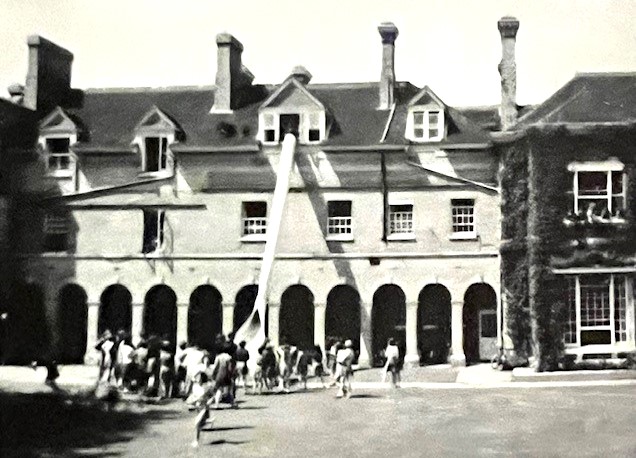
Another amusing event involved Lucy Albelson, one of my contemporaries. Lucy set off the fire alarm during the night as a practical joke rousing the entire school, and probably the local police and fire dept.
Lucy’s mother was Dr Abelson who was the school doctor and visited to tend to our needs on a regular basis. She was unaware of Lucy’s misdemeanour but Miss Elliott asked her: What would you do to a girl that set of the fire alarm?” without letting her know it was in fact her daughter!
Miss Elliott was also notable for her powers of persuasion. During one of my gruelling chats with her she waved towards a pile of books and enquired: “I don’t know why more of you don’t come and borrow these books on the lives of saints.” I’d never given a thought to saints, but to this day I find myself noticing any books on saints and even read some of them!
I was also great friends with Anne Faber, whose grandfather was Harold Macmillan, the Prime Minister at the time. He and his wife Dorothy held a Christmas party at 10 Downing Street for all their grandchildren and their friends. I was of five West Heath girls to get an invite – just imagine the excitement!
At one point, I wandered off looking for the bathroom and found myself in a room with the Prime Minister himself, standing there looking very grand and imposing in his tails. He asked me, “Are you having a good time, my dear?” He then pointed me in the direction of a bathroom which happened to be behind his bedroom. By his bedside I spotted a book by Anthony Trollope, the English novelist and civil servant of the Victorian era. A small detail which I have never forgotten.
I went through a phase at school of wearing black with a long gold medallion necklace. Miss Elliott clearly didn’t approve. She sent my mother a postcard saying: “I like my girls to look nice but not ridiculous.” My poor mother hadn’t the faintest idea what she was talking about!
Not long after I left the school, I returned to visit West Heath just after my mother had died. I don’t know what I expected Miss Elliott to say but I was taken aback when she showed sympathy and said: “So tragically young,” (my mother was only 42) and added: “Your poor dear father – how terrible.”

Being a typical selfish and self-absorbed 16-year-old, it had not occurred to me how my father might be feeling. I’m positive Miss Elliott was aware of this, and her two remarks influenced me far more than if she had directly encouraged me to consider him.
These days I read so much about bullying and meanness in schools, but I never encountered any during my time at West Heath. We were all very supportive and protective of each other. I never felt threatened or competitive. I left at the age of 16 before going into Elm, much to the irritation of Miss Elliott who told my parents ‘but she’s not educated yet!’
What a happy place to have spent some of my teenage years.
- These are just some of Gail’s recollections from her time at West Heath. Look out for more of her memories from school events in the future.
- The photos in the piece are just a few from her personal collection. You can see more in a slideshow by CLICKING HERE.
- Maybe you will recognise yourself, or a parent, or relative who went to West Heath in the 50s. Many of the photos are only accompanied by first names – or no names. But with Gail’s help and input from other old girls we can fill them in as we go along.
Gail’s life away from school – and how she ended up in America
My life outside school felt like a completely different world. I grew up as an only child in London, in quite a sophisticated Chelsea environment. Compared to that, most of the West Heath families seemed incredibly stable and wholesome. A lot of them were from Scotland, and I absolutely loved going to stay with them during the holidays. It was such a contrast—especially when it came to being picked up from school.
The family of one of my school friends had a farm about an hour’s drive away, and I was lucky enough to be invited to stay with them a few times. They would arrive in an open-backed Land Rover, full of dogs and younger siblings in gumboots. Her mum was so warm and jolly, and welcomed us with hugs and laughter. I loved being with them. It felt so different from my own upbringing.
At home, I was used to a very adult world where I could more or less do whatever I liked. I’d help myself to books from my parents’ shelves, but when I took them into school, quite a few were confiscated during ‘beginning of term inspections’ for being unsuitable!

After leaving school I landed a job as one of the ‘war office girls’ and later was posted to the British Embassy in Washington DC. I loved living in the country and managed to stay by getting a job with the London Daily Telegraph where mixed my role as office manager with photography when I took the pictures that went with interviews.
This employment enabled me to get a visa. I eventually became a professional photographer and married an American lawyer in 1977.
By coincidence Julie Brough, another West Heath old girl, also worked at the Washington embassy as the same time. She was older than me and said she rather disapproved of Miss Elliott filling our heads with her own political opinions.
As previously mentioned, I wasn’t at all interested in sports at school. So, it came as quite a surprise that all three of my children turned out to be excellent athletes in America. My daughter played lacrosse at college and even stayed on to help coach a team that won the national championships. One of my sons got a baseball scholarship, and the other became an ice hockey player—and is now a teacher who coaches the school tennis team.
I’ve definitely paid my dues, sitting on bleachers year after year watching them all play. And now it seems my grandchildren are heading the same way.


